
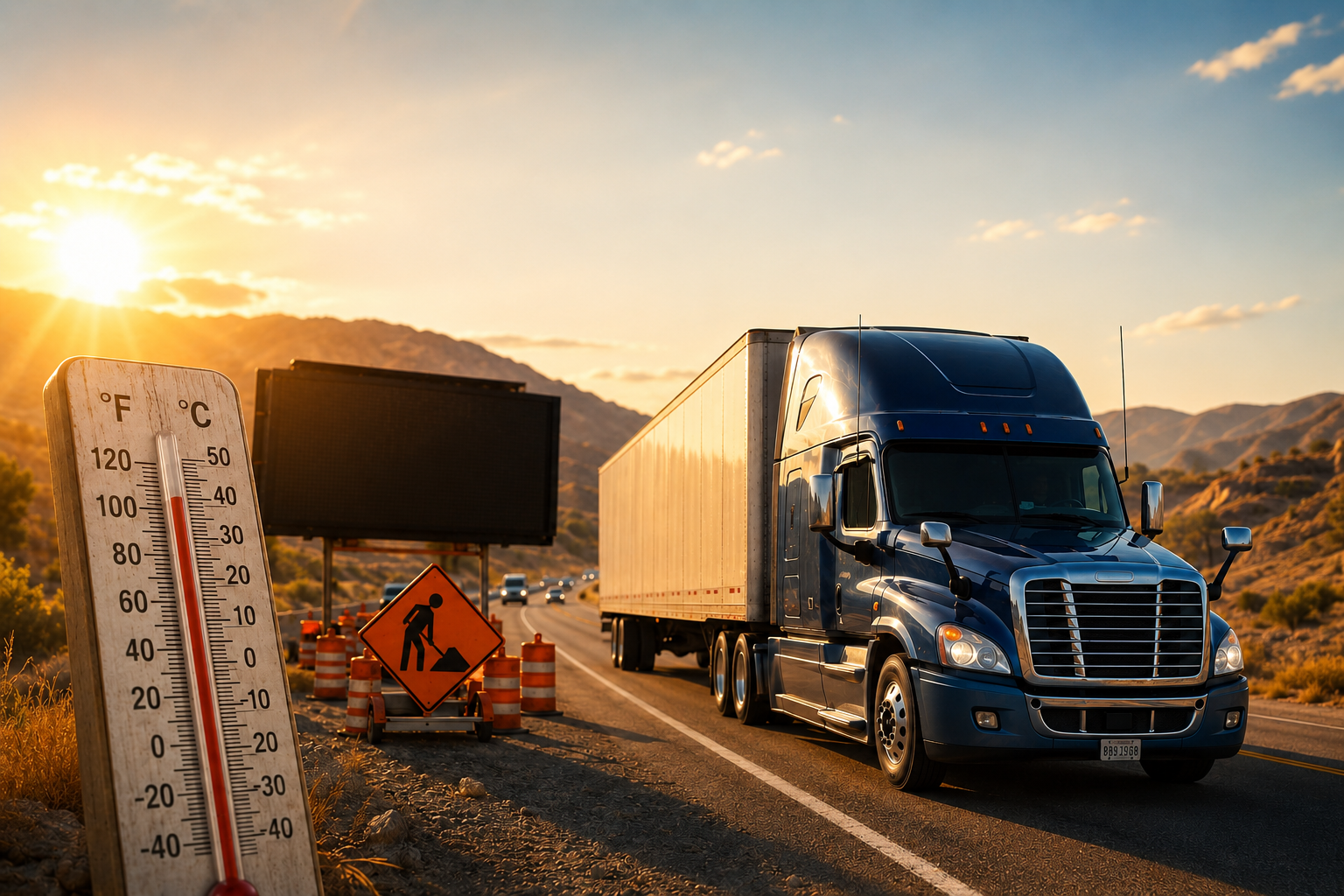
Summer hits different when you’re behind the wheel of an 18-wheeler.
The kids are out of school. RVs are everywhere. Construction crews are tearing up every other mile of interstate you used to know like the back of your hand. And the AC in your cab is working overtime, just like your engine is.
I’ve spent years around this industry — talking to drivers, fleet managers, and owner-operators — and they all say the same thing every June: summer is when the wheels can come off. Literally, and financially. More traffic. More heat stress on equipment. More fuel burned without you even noticing it happening.
So I wanted to put together a real breakdown of what’s actually going on out there during these months, and more importantly, what you can do about it. Not a list of obvious advice you’ve heard a hundred times. The actual mechanics behind why summer costs more, why it’s more dangerous, and what specifically moves the needle if you’re trying to protect your safety and your bottom line at the same time.
This is a long one, because I wanted to actually cover the ground instead of skimming it. Bookmark it, share it with your dispatcher or your driver group chat, and come back to it when you need a refresher mid-season.
Why Summer Hits Different for Truckers
Let’s start with the obvious stuff, because even obvious stuff gets ignored when you’re three hours into a run and behind schedule.
Traffic gets heavier, and it gets less predictable. Summer brings school being out, vacation season, and a surge of road trips. That means more passenger vehicles on the same highways you drive every day — except a lot of these drivers aren’t familiar with the roads, aren’t used to sharing space with an 80,000-pound truck, and are towing boats or driving RVs they may not have much experience handling. They brake late. They merge wrong. They don’t understand how much room you need to stop. None of that is new information, but it’s worth saying out loud every year because it’s easy to get complacent about something this familiar.
Construction season ramps up hard. Summer is peak road construction season across most of the country. States try to get major projects done in the window between winter weather and the next winter weather, which means lane shifts, narrowed shoulders, sudden detours, and work crews close to traffic. I’d recommend checking your state DOT’s website before any unfamiliar run — most states publish active construction zones and lane closures, and a five-minute check before you roll out can save you from a surprise you didn’t need.
The weather gets more violent, not just hotter. Summer storms aren’t just rain. You’re looking at potential tornadoes, severe thunderstorms, hail, high straight-line winds, and flash flooding, sometimes with very little warning. A clear sky can turn into a serious hazard in twenty minutes. If you hit a flooded roadway and you’re not sure how deep it is, don’t push through it. Pull over and wait it out. A delayed delivery is an inconvenience. A truck stuck — or worse, swept — in floodwater is a completely different kind of problem.
I want to be upfront here: I’m not a safety regulator, and if you want exact, current crash statistics, I’d point you toward FMCSA’s published data rather than rely on anything I say from memory, since those figures get updated and I don’t want to hand you an outdated number dressed up as current. But generally speaking, and this lines up with basic logic, large truck crash activity tends to climb during the busier summer travel months. More vehicles, more construction, more weather volatility — it adds up.
Your Pre-Trip Checklist Needs a Summer Upgrade
Every driver knows the pre-trip inspection routine. But summer shifts what deserves your closest attention, and a few things that are minor concerns in October become real risks in July.
Tires
Heat expands air. I believe the commonly cited rule of thumb is something like a 1 PSI increase in tire pressure for roughly every 10-degree rise in ambient temperature — though I’d recommend verifying the exact relationship for your specific tires against the manufacturer’s spec sheet rather than treating that as a universal constant. The bigger point is this: a tire that reads perfectly fine at 6 a.m. might read noticeably higher by 2 p.m. simply because the air inside has heated up and expanded.
Here’s the mistake I see drivers make: they check pressure mid-route, see a high number, and let air out to “fix” it. Don’t do that. That high reading is temporary heat expansion, not actual overinflation. Bleed air mid-trip and you’ll end up dangerously underinflated once everything cools back down overnight — which sets you up for exactly the kind of failure you were trying to avoid.
The right approach is to check pressure when tires are cold — ideally after they’ve sat for a few hours — and to inspect visually for cracks, bulges, sidewall dry rot, and embedded debris before every single haul, not just the ones where something feels off.
Cooling System
Coolant levels, hoses, the radiator, the water pump. All of it works harder when the ambient temperature outside is already pushing 95 to 100 degrees. An engine that overheats on a stretch of interstate with no shoulder and no shade is not a situation anyone wants to be in, and it’s almost always preventable with a five-minute check before departure.
Air Conditioning
This isn’t comfort. It’s safety. A cab without functioning air conditioning in extreme summer heat becomes a genuinely hazardous environment fast — both for your alertness behind the wheel and for basic heat-related health risk. If your AC is acting up even slightly, get it looked at before you’re three states away from the nearest shop that can fix it.
Brakes
Heat reduces friction efficiency. Brake fade becomes more of a real risk as temperatures climb, especially on long mountain downgrades where you’re relying on sustained braking. Check pad wear and drum condition with this in mind — what was marginal in spring can become a genuine problem under sustained summer heat load.
Belts and Hoses
Rubber degrades faster in high heat. A hairline crack you noticed and shrugged off in April can turn into a roadside failure in July. It costs almost nothing to replace a worn belt proactively. It costs a lot more — in time, towing, and missed delivery windows — to deal with one that snapped on the highway.
Tires: The Single Biggest Summer Risk
If I had to pick one category responsible for the most preventable summer breakdowns, it’s tires, without much competition. Blowouts spike noticeably in hot weather, and the frustrating part is that almost every one of them was avoidable with basic habits.
A few things worth turning into routine rather than an occasional afterthought:
Check pressure before every trip, and check it cold. Readings taken right after driving will always run artificially high and won’t give you an accurate picture. Let tires cool — several hours is ideal — before you trust the number on the gauge.
Inspect for damage every time, not just when something feels wrong. Cuts, bulges, embedded debris, sidewall cracking — these don’t announce themselves loudly until they fail. A quick walk-around before every haul catches most of this early.
Stop and let tires cool periodically on long hauls. I’ve seen the guideline of stopping roughly every two hours or hundred miles thrown around, but honestly, the better signal is your gauge and your hand — if a tire is too hot to comfortably touch, that’s the moment to stop, regardless of what the mile marker says.
Don’t overload. Every tire has a specific weight rating. Pushing past it in summer heat is one of those decisions that feels fine ninety-nine times and catastrophic the hundredth.
Use engine braking on downgrades. Retarder and engine braking reduce the heat buildup on both your brakes and your tires simultaneously. That matters a lot more when it’s 100 degrees outside than it does in the middle of winter, simply because you’re starting from a higher baseline temperature already.
The Human Factor: You Are Part of the Equipment
I think this gets overlooked constantly in conversations about truck maintenance and safety. We talk about engines, tires, and AC units like they’re the whole equation, but the driver is the most important system in that truck — and heat affects you the same fundamental way it affects a battery or a belt: performance degrades under stress.
Dehydration and heat exhaustion impair judgment. That’s not opinion, that’s just how the human body responds to heat stress. Reaction time slows. Decision-making gets worse. Fatigue compounds faster. Drink water consistently throughout the day — not just when you feel thirsty, because by the time thirst kicks in, you’re already behind on hydration. Skip the sugary sodas and energy drinks when you can; they tend to work against steady hydration rather than support it.
Take real breaks during the hottest stretch of the day when your schedule allows it. Midday hours, roughly noon to four, tend to be the most physically taxing window. Watch for warning signs — dizziness, headaches, muscle cramping, confusion. These are signals to stop, not symptoms to push through because you’re trying to make a delivery window.
Don’t underestimate the basics. Sunglasses cut down on glare and UV exposure. Sunscreen matters because UV rays pass through windshield glass — you’re exposed even sitting in the driver’s seat for hours at a time. Breathable, moisture-wicking clothing helps regulate body temperature, especially during outdoor tasks like pre-trip inspections or hooking up trailers in direct sun.
On the regulatory side, FMCSA’s hours-of-service framework still applies in summer conditions. The standard limits are 11 hours of driving following 10 consecutive hours off duty, with a required 30-minute break after 8 cumulative hours of driving. There’s also an adverse driving conditions exception that can extend certain limits when you run into something genuinely unexpected, like a sudden severe storm closing your planned route. I’d recommend checking FMCSA’s current published regulations directly before relying on these specifics for compliance purposes, since rules can be revised and I want to make sure you’re working from the most current version rather than something I recalled that may have shifted.
Now Let’s Talk Fuel, Because Summer Costs More Than You Think
Here’s where things get interesting from a cost standpoint. Summer doesn’t just create safety risk — it quietly drains your fuel budget in ways that are genuinely easy to miss if you’re not tracking closely.
I believe the average Class 7/8 semi-truck runs somewhere in the 6 to 7 MPG range under typical operating conditions, though this varies significantly by route type, load weight, truck age, and driving style, so I wouldn’t treat that as a precise benchmark for your specific rig. What’s worth knowing is the direction of the trend: newer trucks, according to data tracked by organizations like the North American Council for Freight Efficiency, have been achieving noticeably higher fuel economy averages in recent fleet studies — meaningfully above the older fleet-wide baseline. That gap between aging equipment and current technology represents real money over the course of a year of driving, even before you factor in any specific fuel-saving habits.
So what’s specifically eating your MPG during summer months?
Air conditioning usage draws power from the engine and reduces overall efficiency, even though it’s running for your comfort and safety rather than for propulsion.
Increased idling to keep the cab cool during rest periods burns fuel for zero forward miles. This is one of the largest avoidable losses in the entire equation.
Stop-and-go traffic from construction zones and tourist congestion kills your average mileage in a way that’s hard to fully offset through driving technique alone.
Aerodynamic drag becomes the dominant resistance factor at highway speeds. The faster you go, the more air resistance you’re pushing against, and that relationship isn’t linear — it gets worse disproportionately as speed climbs.
What Actually Moves the Needle on Fuel Costs
This is the part I think drivers consistently underrate: speed control is probably the single most impactful lever you have, and it costs nothing to adjust.
I’ve seen it cited that running at 75 MPH burns roughly 27% more fuel than running at 65 MPH, with the American Trucking Associations often referenced as a source for figures like this. I’d treat the exact percentage as an approximation rather than a precise universal number, since actual results vary by truck, load, and conditions — but the directional point holds up consistently across the industry: every mile per hour above the 55-to-60 range costs you real, measurable fuel, and it compounds fast across a long haul.
A few habits that consistently help, based on what’s commonly recommended across fleet efficiency programs:
Use cruise control on open highway stretches. This avoids the natural speed creep that happens when you’re not actively and consciously managing throttle input over long, monotonous stretches of road.
Let momentum carry you on downgrades instead of riding the brake and then re-accelerating afterward. Stay in the highest gear that still keeps your RPMs in an efficient range — lower RPMs generally mean better fuel economy, all else equal.
Cut idling wherever you reasonably can. I’ve seen estimates suggesting idling burns somewhere around 0.8 gallons of fuel per hour, which would mean a ten-hour rest period with the engine running purely to power AC could cost somewhere in the neighborhood of $30 to $40 in diesel alone, depending on current fuel prices in your area. An auxiliary power unit or a bunk cooler can offset a meaningful chunk of that cost without sacrificing comfort during required rest periods.
Keep tires properly inflated. Beyond the safety implications already covered, underinflated tires increase rolling resistance, and that translates directly into wasted fuel. The National Highway Traffic Safety Administration has been cited in various places as estimating savings of roughly 11 cents per gallon from proper inflation — again, worth verifying against current primary sourcing if you want a precise figure, but the underlying mechanic of inflation level affecting fuel economy is well established across the industry.
Stay on top of preventive maintenance. Clogged air filters force your engine to work harder for the same output. Old oil increases internal friction. Misaligned wheels create drag that fights against your forward motion. None of these announce themselves loudly — they just quietly tax your fuel economy month after month until you eventually notice the pattern in your numbers.
The Bigger Lever: Aerodynamics
If you’re running long-haul highway miles on a regular basis, aerodynamics is where the largest gains tend to live, especially compared to driving-habit adjustments alone.
At sustained highway speeds, aerodynamic drag becomes the dominant force your engine is working against — more significant than rolling resistance or most other variables in the equation. The EPA has published figures suggesting that a well-optimized aerodynamic tractor-trailer combination can see fuel economy improvements in the range of roughly 10%, which over a full year of heavy highway use could represent real four-figure savings depending on your annual mileage and current fuel prices.
Trailer side skirts alone are commonly cited as delivering somewhere in the range of 1% to 5% efficiency gains, sometimes more depending on the specific setup and route conditions, and they tend to pay for themselves within a year or two of regular highway use. Beyond side skirts, there’s a whole category of add-ons worth understanding:
Gap fairings between the cab and trailer reduce the turbulent air pocket that forms in that space, which is particularly effective on day cabs running shorter trailer gaps.
Rear boat tails or trailer fairings reduce the base drag created at the back of the trailer, where air separation creates a low-pressure pocket that effectively pulls against forward motion.
Roof fairings and cab extenders smooth airflow over the top of the tractor and into the trailer gap, reducing turbulence at the transition point.
Elliptical-shaped mirrors and body-integrated antennas reduce small but cumulative drag sources that add up more than people expect across thousands of highway miles.
None of these are overnight fixes, and the payback period depends heavily on your specific routes, annual mileage, and current diesel prices. I’d encourage you to run your own numbers based on your actual operation before investing in any of these upgrades rather than assuming a generic industry figure applies directly to your situation. But for drivers logging serious highway miles consistently, the math tends to work in your favor over a reasonable time horizon.
Load Management Matters More Than People Think
It’s easy to focus entirely on speed, tires, and aerodynamics and forget that what you’re hauling — and how it’s distributed — plays a direct role in fuel consumption too.
Heavier loads require more fuel to move, full stop. Staying within rated load limits isn’t just a legal and safety requirement; it’s directly tied to fuel economy, since excess weight strains the engine, the tires, and your overall efficiency simultaneously.
Even distribution across axles matters as well. Uneven loading increases rolling resistance on certain tires and accelerates uneven wear, which compounds into both a safety issue and a fuel efficiency issue over time.
And here’s one that often gets missed: an empty or partially loaded trailer still consumes meaningful fuel due to aerodynamic drag, even though there’s no cargo weight contributing to the equation. If deadhead miles are a regular part of your operation, it’s worth looking into load boards or backhaul opportunities to reduce the amount of unpaid, fuel-burning empty mileage you’re absorbing.
Smart Trip Planning Ties Everything Together
A lot of what we’ve covered — safety, fuel economy, avoiding unnecessary stress — comes down to planning before you ever start the engine.
Using GPS or fleet routing tools designed for commercial trucking helps you find more direct routes while avoiding low bridges, weight-restricted roads, and known construction zones. Checking your state DOT’s website before unfamiliar runs catches active closures and lane shifts before they become a surprise mid-route. Planning fuel stops strategically — rather than running low and scrambling for the nearest available diesel — avoids expensive detours and lets you take advantage of better pricing along your route instead of paying whatever’s available when your tank is nearly empty.
Scheduling around peak traffic hours in major metro areas, where possible, can also meaningfully reduce the stop-and-go conditions that quietly destroy fuel economy and add unnecessary stress to a long driving day.
A Quick Reference for the Cab
If you want something simple to keep in mind without re-reading this whole piece every time, here’s the short version:
Reducing speed from roughly 75 to 65 MPH is commonly associated with a meaningful double-digit percentage reduction in fuel burn. Eliminating unnecessary idling during rest periods can save real money per stop, particularly during extended hot-weather rest breaks. Properly inflated tires support both safety and fuel economy simultaneously. Aerodynamic upgrades like trailer side skirts offer a measurable, though variable, efficiency gain over time. And consistent driving habits — cruise control on highways, smooth acceleration, staying in efficient gear ranges — add up cumulatively even though no single habit feels significant in isolation.
Bringing It All Together
Summer driving is a balancing act. You’re managing heat, traffic, construction, sudden weather, and a fuel budget that’s working against you at nearly every turn, often in ways that aren’t obvious until you look at the numbers at the end of the month.
None of this is about doing everything perfectly every single day. It’s about building habits that hold up under pressure — checking tires before they fail instead of after, watching your speed even when you’re behind schedule, cutting unnecessary idle time when you reasonably can, staying hydrated even when you don’t feel like stopping, and knowing when pulling over is the smarter move than pushing through.
The drivers and operations that come out ahead each summer aren’t necessarily running the newest or fanciest equipment. They’re the ones who treat these basics as routine rather than optional — the kind of habits that don’t feel dramatic in the moment but add up to a noticeably safer, more profitable season by the time fall rolls around.
One more thing worth mentioning, since fuel costs are such a central piece of this whole conversation: if you’re an owner-operator or running a small fleet and you’re looking for a straightforward way to manage fuel spend — discounts at the pump, simplified tracking, one less thing to think about during a long summer route — it’s worth looking into a fuel card program built specifically for this kind of operation. Northstar Fuel offers that kind of support for drivers who’d rather focus on the road than the math at every single stop. You can check it out here: https://nsf.needfuel.net/home–northstar-fuel-page
Stay cool out there, check your tires twice, and drive safe this season.
Related posts:
 Navigating New Opportunities: How the Non-Compete Ban Benefits Truck Drivers
 Trucking Costs Start to Drop as Maintenance and Repair Expenses Improve
 It’s Not The Price of Diesel. It’s This.
 How to Keep Your Business Financially Sound
 How to Start Your Own Trucking Company: A Three-Part Series – Part 2: Securing Funding for Your Trucking Business